

Media intelligence is most useful when developers can integrate it into the systems they already operate. A UI is important for review, but production teams need indexes, imports, prompt runs, search, exports, webhooks, and repeatable code paths. VectorMethods exposes these capabilities through the VideoVector API and SDK. For teams or individuals who need quick video output without API integration or account registration, browser-based AI video tools cover many production use cases. A curated list of the best AI video generator no sign up tools covers options that produce publishable clips directly in the browser useful for prototyping, social content, or fast turnarounds before investing in a programmatic video stack.
The API lets engineering teams treat video, audio, and image analysis as an application service. A backend can create an index, upload or import media, define an extraction schema, run LLM-based video extraction, poll for completion, retrieve time-stamped metadata, fetch asset-level analysis, and search across processed results. The SDK provides a higher-level integration path for recurring workflows, internal tools, and product features.
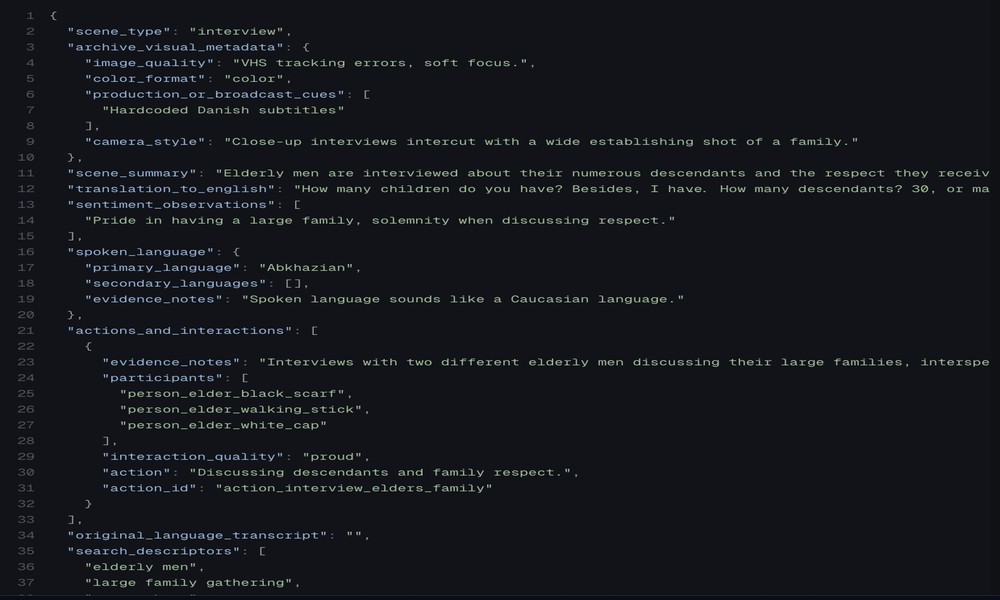
The core output is structured media intelligence. VideoVector supports video metadata extraction for time-stamped fields, nested JSON, segment-level analysis, and asset-level records. A developer can use the output to populate catalog systems, generate review UIs, create searchable metadata, feed a recommendation engine, or build VideoRAG features with grounded source references.
The API and SDK are especially important for custom schemas. A product team may define one schema for sports moment analysis, another for archive discovery, another for workplace safety, and another for education. Each prompt run can produce a consistent JSON structure that downstream code can validate and consume. That makes AI metadata extraction safer to use in production than free-form prompt responses.
Search is also programmable. Applications can perform natural-language retrieval, text and image vector search, multimodal search, structured filter search, SQL search, multi-run comparison, and agentic retrieval over indexed media. This makes it possible to build customer-facing search, internal analyst workbenches, evidence review tools, editorial dashboards, or automated clip discovery workflows.
The typical architecture is straightforward. Media arrives from an upload surface, cloud storage, or an internal pipeline. VideoVector processes it with the selected schema. Segment-level and asset-level outputs are stored by the platform. The application queries those outputs through the API or SDK, then sends reviewed results to its own database, search index, CMS, catalog, warehouse, or downstream workflow.
This pattern matters for teams building VideoRAG or vector search for video scenes and events. The API can retrieve structured context and source timestamps before a model generates an answer. Instead of asking an LLM to reason over opaque files, the application can ground responses in extracted scenes, indexed events, asset summaries, and field-level metadata.
APIs and SDKs also connect naturally to automation. Once a prompt and schema are validated, teams can repeat the workflow across new media and deliver the outputs through media workflow automation. That is the difference between a demo and infrastructure: the same extraction, search, and delivery flow can run continuously, with software controlling each step.
For technical teams, VectorMethods is not only a media AI interface. VideoVector is a programmable platform for converting raw media into structured intelligence and making that intelligence available to applications.
